 |
Saturday, March 28
Tools and Techniques -A Spring Genealogy Workshop (Genealogy Workshop)
8:30 am to 4:30 pm
Home Economics Building UNL East Campus
TOOLS AND TECHNIQUES - A SPRING GENEALOGY WORKSHOP
The purpose of this workshop is to:
The workshop will be in the Home Economics Building on UNL East Campus during UNL Spring Break thus allowing easy parking and access to several classrooms including a large auditorium with desks as well as the use of two computer labs. Lunch is included in the registration. Presenters are Nebraska area experienced and professional genealogists who will share their expertise. Twenty different sessions will be available and printed syllabi with all handouts provided. Stay tuned for updates and think about people to invite to attend.
CLICK HERE for Workshop information and how to sign up!
CLICK HERE for Workshop Details
Text and graphics from: http://www.llcgs.info/
Go to the above Lincoln to find out about meetings and classes sponsored by Lincoln Lancaster County Genealogical Society
|
Wednesday, March 11, 2015
Spring Workshop by Lincoln/Lancaster County Genealogical Society

Tuesday, March 10, 2015
German American Midwives
In 1930 my father, Harvey Gesch, was born at home and was probably delivered by one of these midwives.
Article http://www.nebraskahistory.org/publish/publicat/history/excerpts-4-13.htm


Winter 2013 Issue Excerpts
“Grandma Gable, she brought Ralph”: Midwifery and the Lincoln, Nebraska, Department of Health in the Early Twentieth Century - Rebecca J. Anderson

Eight midwives gathered at Lincoln’s North Side Neighborhood House on a cool and rainy July afternoon in 1915 to meet with Dr. Chauncey Chapman, the Lincoln Department of Health’s newly appointed superintendent. Chapman had officially begun his duties just the day before and one of the first items on his agenda was the organization of the midwives. Earlier in his career, Chapman had worked with Chicago’s health department, which had been regulating and supervising midwives since 1896. Chapman hoped that the Lincoln midwives would voluntarily agree to a similar arrangement. At the time that he called the midwives together, he was aware of nine midwives who had attended one-sixth of all the births registered in Lincoln the previous year. Unfortunately, Dr. Chapman was unaware until shortly before the meeting that most of the midwives could not understand English. So while they were all gathered together, visiting nurse Catherine Wollgast, whose parents had brought her to the United States from Germany as a young child, did her best to translate Chapman’s message.
Monday, March 9, 2015
Irish Stew
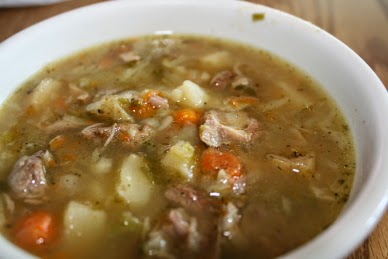
Irish Stew
serves 2-3
2 teaspoons Coconut or Olive oil or just use butter
1/2 pound lamb shoulder steak cut into bite size pieces (can use beef)
1/2 pound diced potatoes
1/2 cup onions, diced
1/2 cup leeks, finely sliced (my little store did not have leeks so I got scallions (green onions) and used them instead)
1/2 cup chopped carrots
3 cups chicken stock
1/2 cup shredded cabbage
1/4 teaspoon each, thyme, marjoram, rosemary
1 small bay leaf
Kosher salt and pepper to taste
- In a frying pan heat half the oil to hot but not smoking. Add half the lamb pieces and brown all over. Remove the lamb and place in a casserole, cover with a half of the potatoes, onions, leeks and carrots.
- Add the remaining oil to the frying pan, heat again then add the remaining lamb and brown all over. Add to the casserole and cover with the remaining vegetables
- Add the stock, cover with a tight fitting lid, cook in the oven for 1 hour. Add the cabbage replace the lid and cook for another hour. Check from time to time to make sure the stock isn't reducing too much, if it is add a little boiling water. The meat and vegetables should always be covered by liquid. If the sauce is too runny at the end, cook a little longer with the lid removed. Season with salt and pepper
Sunday, March 8, 2015
Nebraska Genealogy Page

Nebraska Genealogy
Nebraska was once considered a part of the Great American Desert until the pioneers, hunters and homesteaders came west. Today, Nebraska is the leading farming and ranching state due to the greater vision of those thousands of men and women who treaded its soil to change their future. (text from nebraskagenealogy.org and photo from www.nebraskahistory.org)
This page now has links on where to find information on Nebraska Genealogy. This page is a work in progress.
See Link above
Monday, January 26, 2015
Because She Loved Me
 |
| Palpsdorf Germany |
The woman who made me feel the most loved in my young life was my paternal grandmother. Being a German Immigrant from Russia she had several names. She was born Maria Elizabeth Rebensdorf to her parents Johanne Gottlieb Rebensdorf and Katherine Elizabeth Litt both from Dinkle, Russia but of German descent.
They came to live in Russia because Maria's 3rd great-grandfather, Frederick Rebensdorf, lived in what is now Palpsdorf, Holstein, Germany. At the time, however, the area was actually under Dutch rule. Discouraged by Religious intolerance, the continued warfare in central Europe, as well as dark economic conditions, Frederick took the Russian Czarista and German Princess Catherine the Great's offer of land and annual spipens to move to Russia. Catherine's idea was that the German farmers would bring progressive ideas to Russia and growth. In addition to the land and stipens, Catherine the Great promised the Germans would be free from military service and most taxes.
In 1766, my 4th great-grandfather, Friedrick Rebensdorf, age 25, and his young wife Anna Magdalina Schultz, age 21, began the nine to eleven month journey to Dinkle, Russia and are listed as among the earliest settlers to the Volga Region of Russia having established the village 12 May 1767. Now in the late 1880's, when Grandma was born, the Stipens had never been as much as were promised and now were no longer in existence, the land was poor, eventually they were taxed, and now young men were forced in to the Russian Army, usually for life.
Though life in the old country was seldom spoken of because of the hardships they endured,
 Grandma told me of how the farmers lived in the village and farmed days out on the land. She reminisced of how sometimes they spent days out on the farm land and the family would live in a 'dug-out'. She made a game of jumping off the front of the dug-out roof to the ground 10 feet below. Her home, she said, looked like a picture that hung in her basement living quarters in the North Russian bottom of Lincoln, Nebraska. That picture now hangs in my living room so that I can remember her often.
 |
| Grandma's Doll, Susie |
 |
| My Grandfather, August Gesch, JR |

Grandma spent a lot of time with my family, in our home, her home, on vacation to California to see her son, my Uncle, and weekend hunting trips or Sunday drives. If you visited on a Saturday you were sure to find Cadoval Vereniki, Runzas, Roast Chicken or Fried Fresh German Wurst bought from Riefsnieders Grocery a few blocks away. Plus, if Grandma knew I was coming she would make a Cherry Pie, my favorite.
My father, Harvey was her youngest son and my younger brother and I her youngest grandchildren.
 |
| Marie Gesch and Son Harvey Harvey was my father. |
Because I was raised in a time when children were to be seen and not heard I listened a lot to the conversations of the adults spoken in English and German, I looked at the picture that reminded Grandma of her homeland and imagined what it would be like if I were to live there. I spent countless hours trying to find four-leaf clovers in the grass at my grandmothers, often bare feet as the adults enjoyed their conversations. I also sat for hours near her, playing in the drawers of her treadle sewing machine as she sewed steadily along.

I would often spend the night in grandmother's feather bed and days helping her water her Lily of the Valleys, ferns, her garden and peach
tree. When I was in my early teens instead of taking the bus home, I would walk two miles to my grandmothers home after school where we would sit and talk or she would teach me to cook ethnic foods from the old country. Then I would walk another 2 miles the rest of the way home before supper or my Dad would pick me up on his way home from work.
In High School I took a German Class. I was so excited to get to Grandma's house and show her what I had learned. Sadly, she could not understand the High German I was being taught. She, my dad and the rest of her family spoke a dialect of Low German only spoken in the Saxon area of Germany/Denmark where the family had originated. My only reason for taking the class was to be able to join in their conversations, so since the class had no real value for me, I quickly dropped it.

One thing I never heard from my grandmother was a harsh word towards me except when she would tell me to eat more because I was to skinny in her broken English. I always knew that I was loved. The best thing I remember is her old German Bible that sat on the table in her living room with the appearance of being well read. My grandmother died not long after I graduated high school and I was devastated. Her death certificate called her Mary Elizabeth Gesch, I called her Grandma.
Subscribe to:
Posts (Atom)